Could Florida's Proposed $250,000 Homestead Exemption Push Miami-Dade Home Prices Higher?A Miami-Dade Real Estate Market Update by Win With NaffahFlorida homeowners could soon see one of the largest

Dated: May 14 2026
Views: 8

The 2026 Michigan real estate landscape represents a pivotal "market reset," characterized by the erosion of the restrictive "lock-in effect" and the emergence of a more balanced, sustainable transaction environment.
The current year, 2026, is widely viewed by economists as "The Unlock".
The Michigan housing market enters the second quarter of 2026 with a median home price that has shown remarkable resilience, reaching $272,000 as of March, a 4.6% increase year-over-year.
The primary catalyst for the 2026 shift is the improvement in affordability relative to the peak-rate period of 2023–2025. While home prices continue to rise modestly, projected at a 2.2% annual increase for the year, the decline in mortgage rates has resulted in the first reduction in typical monthly payments since 2020.
| Metric | March 2025 | March 2026 | Year-Over-Year Change |
| Median Sale Price (Michigan) | $260,000 | $272,000 | +4.6% |
| Active Inventory (Units) | 17,429 | 19,643 | +12.7% |
| New Listings (Monthly) | 11,827 | 12,125 | +2.5% |
| Average Days on Market | 47 | 50 | +3 Days |
| List-to-Sale Price Ratio | 98.7% | 98.5% | -0.2% |
The data provided by Realcomp and Michigan Realtors illustrates a market that is "loosening" but remains firmly in the seller's favor.
The defining characteristic of the 2026 seller’s market is the fading "lock-in effect." For years, homeowners with pandemic-era mortgage rates of 2.5% to 3.5% were reluctant to trade those rates for 7.00% or 8.00% financing, which kept inventory levels artificially low.
For those selling a home in Michigan spring market, this means there is a more diverse and active group of "move-up" buyers. These are individuals who are selling their entry-level properties to capture significant equity gains, often averaging over $128,000 over the past six years, and deploying that capital into larger homes in desirable school districts.
While national reports often identify mid-April as the "best week" to list a home, the specific climatological and cultural factors of the Midwest push the peak performance window for Michigan into May.
In the Michigan market, May consistently delivers the highest sale-to-list price ratios and the strongest median sale prices of the spring season. Analysis of seasonal pricing trends shows that homes listed in May can earn a "seller premium" that is significantly higher than winter or late-summer listings.
| Month | Seller Outlook | Pricing Strength | Avg. Price Premium |
| January | Weak | Soft | -2.8% |
| March | Moderate | Improving | +0.4% |
| April | Strong | Strong | +1.3% |
| May | Very Strong | Very Strong | +1.6% to +2.1% |
| June | Strong | Peak | +1.2% |
| July | Moderate | Softening | 0.0% |
The "Very Strong" rating for May is supported by Redfin and Zillow data, which identifies May as the month with the biggest seller premium in Michigan.
Market pace, measured by median days on market (DOM), is at its swiftest in May. Michigan data shows that while a house listed in January might sit for 80 days, a May listing typically finds a buyer in just 30 days.
Furthermore, the Realcomp data for March 2026 indicated that 31.9% of new listings were both listed and pended within the same month.
Buyer demand is a function of both psychological urgency and physical accessibility. In Michigan, the arrival of May brings more than just warmer weather; it brings a significant increase in listing visibility.
This visibility is magnified in 2026 by the "re-entry" of buyers who were sidelined by higher interest rates in 2024 and 2025. With rates stabilizing, the pool of qualified buyers has expanded by an estimated 5.5 million households nationally.
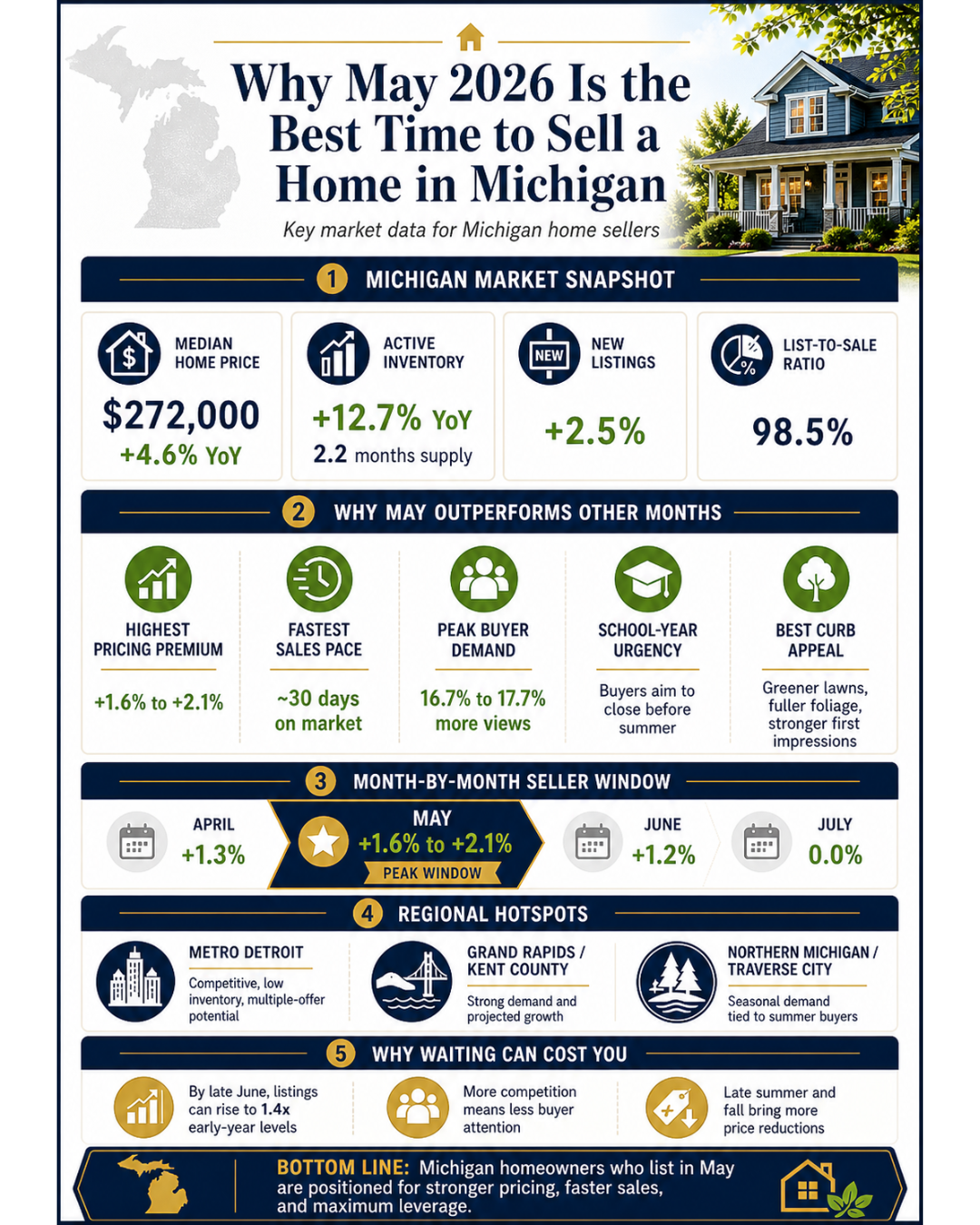
The timing of a Michigan home sale is inextricably linked to the state’s unique seasonal rhythm. For a seller, understanding the "why" behind the May peak is just as important as knowing the data. The intersection of the academic calendar, the "Greening of Michigan," and regional economic shifts creates a perfect storm for seller leverage.
The most powerful driver of May's demand in Michigan is the school year. Michigan’s major school districts, including Ann Arbor Public Schools and Detroit Public Schools Community District, typically conclude their academic years in mid-June.
| District | 2026 Last Day of School | Critical "Under Contract" Window |
| Ann Arbor Public Schools | June 9, 2026 | May 1 – May 25 |
| Detroit Public Schools | Mid-June (Est.) | May 1 – May 30 |
| Grand Rapids Public | Mid-June (Est.) | May 1 – May 30 |
A standard residential real estate transaction in Michigan takes between 30 and 45 days to close once an offer is accepted. To ensure a move-in date in late June or early July, allowing families time to settle before the next school year begins, the offer must be finalized in May.
In Michigan, the aesthetic transition from April to May is dramatic. April is often characterized by lingering cold, rain, and "gray" landscapes. By May, however, Michigan's curb appeal is at its natural peak. Trees have leafed out, lawns have greened, and spring flowers are in bloom.
For a 2026 buyer, who is increasingly making decisions based on high-resolution digital photography and AI-curated property feeds, the "visual premium" of a May listing cannot be overstated. Homes show better with more natural light and vibrant outdoor spaces, leading to stronger emotional connections and, ultimately, higher offers.
While May is the statewide peak, the "strength" of the seller's position varies by region. Michigan’s real estate market in 2026 is described as "splintered," meaning that different areas are experiencing different levels of inventory recovery.
Metro Detroit (Wayne & Oakland Counties): This region remains one of the most competitive in the country. Metro Detroit inventory is still 34.6% below 2019 levels, creating an environment where a May listing in a "Ring City" like Redford or Royal Oak can still see double-digit offers.
Grand Rapids and Kent County: Projected as a top growth market for 2026, Grand Rapids is seeing strong demand from buyers seeking a high quality of life and lower cost of living (5.5% below national average).
Traverse City and Northern Michigan: This market behaves more as a seasonal second-home destination. The May window here is critical for capturing buyers who want to enjoy the property for the 2026 summer season.
A common psychological trap for Michigan homeowners is the belief that "the weather is even better in July, so I should wait." However, from a strategic real estate perspective, waiting until mid-summer or fall is a high-risk move that often leads to lower net proceeds and longer market times.
The primary reason May outperforms June and July is the level of competition. In May, you are capturing the first wave of serious buyers while inventory is still relatively lean. By the end of June, however, the volume of new listings typically surges to 1.4 times the level seen at the start of the year.
When inventory increases by 38.4% in a single month, buyer attention is diluted. A home that would have been a "must-see" in May becomes just "one of five similar options" in July. This shift in the supply-demand balance reduces a seller’s negotiating leverage. Instead of buyers competing against each other, sellers begin to compete against each other, leading to more frequent price reductions.
By late summer, the "school year deadline" has passed. The buyers who are still searching in August are often those who were "priced out" in the spring or those who are more casual and price-sensitive. Consequently, the sense of urgency evaporates. Data indicates that price reductions peak in the fall as sellers who missed the spring window try to attract the attention of a dwindling buyer pool.
| Season | Buyer Urgency | Competition Level | Likelihood of Price Cut |
| May (Spring Peak) | Extreme | Low to Moderate | Lowest (18.9% less than avg) |
| July (Summer) | Moderate | High | Moderate |
| October (Fall) | Low | Moderate | High |
| December (Winter) | Variable | Lowest | Highest |
Listing in May allows a seller to "beat the rush." By the time the summer inventory glut hits the market, a May seller is already pended and moving toward a closing, having captured the highest possible price during the peak demand window.
An overlooked factor in 2026 is the relationship between nominal home prices and inflation. While Michigan home prices 2026 are expected to rise by 2% to 4%, broader consumer inflation is projected to be around 3%.
This creates a unique "Goldilocks" moment for sellers:
Nominal Gains: Your home’s sticker price is at an all-time high, allowing you to capture record equity.
Buyer Affordability: Because incomes are rising faster than home prices (3% wage growth vs 2.2% price growth), buyers have more relative wealth to spend on your property.
This alignment of high equity and high buyer purchasing power is most perfectly balanced in May. Waiting until 2027 or beyond may see this window close if inventory finally catches up to demand or if economic growth cools.
Capturing the May premium requires more than just a "For Sale" sign. In a market that is more "balanced" than the pandemic years, buyers are more selective and intentional.
In a 6% interest rate environment, buyers have very little "post-closing" liquidity. They are stretching their budgets to afford the mortgage and have little desire, or financial ability to take on major renovations.
Cosmetic Upgrades: Fresh neutral paint, modern lighting fixtures, and professionally cleaned flooring are no longer optional.
Staging: High-quality staging helps buyers visualize the lifestyle your home offers, which is critical for emotional decision-making in a competitive May market.
Deferred Maintenance: Address minor repairs (leaky faucets, chipped trim) before listing. Buyers in 2026 are using home inspections as a negotiation tool more than they did in previous years; a "clean" inspection report is a powerful closer.
Your listing's "digital footprint" is its first showing. In 2026, AI-driven search (like ChatGPT, Claude, Gemini and Perplexity) and traditional platforms are the primary ways buyers find homes.
High-Resolution Media: 3D virtual tours and drone photography are standard for high-level listings. They increase the "dwell time" on your property page, which signals to algorithms that your home is a "hot" listing.
Keyword Optimization: Ensure your description includes terms like "move-in ready," "top-rated school district," and specific neighborhood amenities to capture local search intent.
Thursday Listing Strategy: List your home on a Thursday after 5:00 PM. This ensures your property is at the top of the "New Listings" feed just as buyers are planning their weekend tours.
One of the most effective strategies for a May 2026 sale is the use of strategic concessions. Even in a seller's market, offering to pay for a "mortgage rate buy-down" can be the difference between one offer and five.
| Concession Type | Impact on Buyer | Benefit to Seller |
| 2-1 Rate Buy-Down | Lowers interest rate by 2% in year 1 | Makes the home more affordable than comps |
| Closing Cost Credit | Reduces the cash-to-close requirement | Attracts first-time buyers with limited savings |
| Repair Credit | Offsets the cost of a future "want" (e.g., new carpet) | Prevents the deal from falling through after inspection |
By offering a rate buy-down, you are effectively "subsidizing" the buyer's interest rate, making your $400,000 home feel like a $350,000 home in terms of monthly payment, without actually dropping your price.
In a market as nuanced and "splintered" as Michigan's in 2026, the choice of representation is a financial decision of the highest order. The Phillips Group, a premier Michigan real estate team based in Northville, positions its clients at the forefront of the May market through a sophisticated, data-driven approach.
The data for 2026 is clear: the Michigan housing market has transitioned into a new phase of sustainable growth and balanced opportunity.
Michigan homeowners who list in May will benefit from:
Peak Pricing Power: Capturing the highest seller premium of the year before summer inventory increases competition.
Maximum Market Velocity: Selling in an average of 30 days, compared to 50+ in late winter.
The 6% "Unlock" Advantage: Tapping into a pool of 5.5 million newly qualified buyers seeking to move before the new school year.
The decision to wait until summer or fall is a decision to accept more competition, less urgency, and more frequent price cuts.
To determine the exact market value of your home in the current environment and to develop your May 2026 selling strategy, contact The Phillips Group at (734) 459-7646.

I am the best agent out there!....
Could Florida's Proposed $250,000 Homestead Exemption Push Miami-Dade Home Prices Higher?A Miami-Dade Real Estate Market Update by Win With NaffahFlorida homeowners could soon see one of the largest
Purchasing your first home is an exciting milestone, but it can also feel overwhelming with all the decisions and steps involved. From navigating the real estate market to understanding your budget
 Based on information from California Regional Multiple Listing Service, Inc. as of September 16, 2026 6:13 PM UTC This information is for your personal, non-commercial use and may not be used for any purpose other than to identify prospective properties you may be interested in purchasing. Display of MLS data is usually deemed reliable but is NOT guaranteed accurate by the MLS. Buyers are responsible for verifying the accuracy of all information and should investigate the data themselves or retain appropriate professionals. Information from sources other than the Listing Agent may have been included in the MLS data. Unless otherwise specified in writing, Broker/Agent has not and will not verify any information obtained from other sources. The Broker/Agent providing the information contained herein may or may not have been the Listing and/or Selling Agent.
Based on information from September 16, 2026 6:13 PM UTC The information being provided by CRMLS is for the visitor's personal, noncommercial use and may not be used for any purpose other than to identify prospective properties visitor may be interested in purchasing. The data contained herein is copyrighted by CRMLS, CLAW, i-Tech MLS, PSRMLS and/or VCRDS and is protected by all applicable copyright laws. Any dissemination of this information is in violation of copyright laws and is strictly prohibited.
Any property information referenced on this website comes from the Internet Data Exchange (IDX) program of CRMLS. All data, including all measurements and calculations of area, is obtained from various sources and has not been, and will not be, verified by broker or MLS. All information should be independently reviewed and verified for accuracy. Properties may or may not be listed by the office/agent presenting the information.
 All information deemed reliable but not guaranteed. All properties are subject to prior sale, change or withdrawal. Neither listing broker(s) or information provider(s) shall be responsible for any typographical errors, misinformation, misprints and shall be held totally harmless. Listing(s) information is provided for consumer's personal, non-commercial use and may not be used for any purpose other than to identify prospective properties consumers may be interested in purchasing. The data relating
to real estate for sale on this website comes in part from the Internet Data Exchange program of the Multiple Listing Service. Real estate listings held by brokerage firms other than After 4pm Crew may be marked with the Internet Data Exchange logo and detailed information about those properties will include the name of the listing broker(s) when required by the MLS. Copyright ©2026 All rights reserved.
Last Updated: September 16, 2026 6:08 PM UTC
Show More...
All information deemed reliable but not guaranteed. All properties are subject to prior sale, change or withdrawal. Neither listing broker(s) or information provider(s) shall be responsible for any typographical errors, misinformation, misprints and shall be held totally harmless. Listing(s) information is provided for consumer's personal, non-commercial use and may not be used for any purpose other than to identify prospective properties consumers may be interested in purchasing. The data relating
to real estate for sale on this website comes in part from the Internet Data Exchange program of the Multiple Listing Service. Real estate listings held by brokerage firms other than After 4pm Crew may be marked with the Internet Data Exchange logo and detailed information about those properties will include the name of the listing broker(s) when required by the MLS. Copyright ©2026 All rights reserved.
Last Updated: September 16, 2026 6:08 PM UTC
Show More...
 This information is deemed reliable but not guaranteed. You should rely on this information only to decide whether or not to further investigate a particular property. BEFORE MAKING ANY OTHER DECISION, YOU SHOULD PERSONALLY INVESTIGATE THE FACTS (e.g.square footage and lot size) with the assistance of an appropriate professional. You may use this information only to identify properties you may be interested in investigating further. All uses except for personal, non-commercial use in accordance with
the foregoing purpose are prohibited. Redistribution or copying of this information, any photographs or video tours is strictly prohibited. This information is derived from the Internet Data Exchange (IDX) service provided by San Diego MLS. Displayed property listings may be held by a brokerage firm other than the broker and/or agent responsible for this display. The information and any photographs and video tours and the compilation from which they are derived is protected by copyright.Compilation © 2026 San Diego MLS. Last Updated: September 16, 2026 5:56 PM UTC
Show More...
This information is deemed reliable but not guaranteed. You should rely on this information only to decide whether or not to further investigate a particular property. BEFORE MAKING ANY OTHER DECISION, YOU SHOULD PERSONALLY INVESTIGATE THE FACTS (e.g.square footage and lot size) with the assistance of an appropriate professional. You may use this information only to identify properties you may be interested in investigating further. All uses except for personal, non-commercial use in accordance with
the foregoing purpose are prohibited. Redistribution or copying of this information, any photographs or video tours is strictly prohibited. This information is derived from the Internet Data Exchange (IDX) service provided by San Diego MLS. Displayed property listings may be held by a brokerage firm other than the broker and/or agent responsible for this display. The information and any photographs and video tours and the compilation from which they are derived is protected by copyright.Compilation © 2026 San Diego MLS. Last Updated: September 16, 2026 5:56 PM UTC
Show More...
 © 2026 Longleaf Pines Association of Realtors MLS. All Rights Reserved. IDX information is provided exclusively for consumers' personal, non-commercial use and may not be used for any purpose other than to identify prospective properties consumers may be interested in purchasing. Information deemed reliable but not guaranteed. Properties marked with the IDX icon are provided courtesy of the Longleaf Pines Association of Realtors MLS, Inc., Internet Data Exchange (IDX).
 Emerald Coast Association of REALTORS®, Inc. All information deemed reliable but not guaranteed. All properties are subject to prior sale, change or withdrawal. Neither listing broker(s) or information provider(s) shall be responsible for any typographical errors, misinformation, misprints and shall be held totally harmless. Listing(s) information is provided for consumer's personal, non-commercial use and may not be used for any purpose other than to identify prospective properties consumers
may be interested in purchasing. The data relating to real estate for sale on this website comes in part from the Internet Data Exchange program of the Multiple Listing Service. Real estate listings held by brokerage firms other than After 4pm Crew may be marked with the Internet Data Exchange logo and detailed information about those properties will include the name of the listing broker(s) when required by the MLS. Copyright ©2026 All rights reserved.
Last Updated: September 16, 2026 6:19 PM UTC, Inside Real Estate Vendor ID: 28326
Show More...
Emerald Coast Association of REALTORS®, Inc. All information deemed reliable but not guaranteed. All properties are subject to prior sale, change or withdrawal. Neither listing broker(s) or information provider(s) shall be responsible for any typographical errors, misinformation, misprints and shall be held totally harmless. Listing(s) information is provided for consumer's personal, non-commercial use and may not be used for any purpose other than to identify prospective properties consumers
may be interested in purchasing. The data relating to real estate for sale on this website comes in part from the Internet Data Exchange program of the Multiple Listing Service. Real estate listings held by brokerage firms other than After 4pm Crew may be marked with the Internet Data Exchange logo and detailed information about those properties will include the name of the listing broker(s) when required by the MLS. Copyright ©2026 All rights reserved.
Last Updated: September 16, 2026 6:19 PM UTC, Inside Real Estate Vendor ID: 28326
Show More...
 All measurements and all calculations of area are approximate. Information provided by Seller/Other sources, not verified by Broker. All interested persons should independently verify accuracy of information. Provided properties may or may not be listed by the office/agent presenting the information. Data maintained by MetroList© may not reflect all real estate activity in the market.
All real estate content on this site is subject to the Federal Fair Housing Act of 1968, as amended, which makes it illegal to advertise any preference, limitation or discrimination because of race, color, religion, sex, handicap, family status or national origin or an intention to make any such preference, limitation or discrimination.
MetroList CA data last updated: September 16, 2026 5:38 PM UTC Terms of Use.
Vendor data provided by Inside Real Estate, LLC.
All measurements and all calculations of area are approximate. Information provided by Seller/Other sources, not verified by Broker. All interested persons should independently verify accuracy of information. Provided properties may or may not be listed by the office/agent presenting the information. Data maintained by MetroList© may not reflect all real estate activity in the market.
All real estate content on this site is subject to the Federal Fair Housing Act of 1968, as amended, which makes it illegal to advertise any preference, limitation or discrimination because of race, color, religion, sex, handicap, family status or national origin or an intention to make any such preference, limitation or discrimination.
MetroList CA data last updated: September 16, 2026 5:38 PM UTC Terms of Use.
Vendor data provided by Inside Real Estate, LLC.
 The data relating to real estate for sale on this web site comes in part from the INTERNET DATA EXCHANGE Program of the Greater Las Vegas Association of REALTORS® MLS. Real estate listings held by brokerage firms other than this site-owner are marked with the IDX logo. The information being provided is for the consumers' personal, noncommercial use and may not be used for any purpose other than to identify prospective properties consumers may be interested in purchasing.
"GLVAR MLS
deems information reliable but not guaranteed."
© Copyright 2026 of the Greater Las Vegas Association of REALTORS® MLS. All rights reserved.
Show More...
 ©2026 Georgia Multiple Listing Service All information deemed reliable but not guaranteed. All properties are subject to prior sale, change or withdrawal. Neither listing broker(s) or information provider(s) shall be responsible for any typographical errors, misinformation, misprints and shall be held totally harmless. Listing(s) information is provided for consumer's personal, non-commercial use and may not be used for any purpose other than to identify prospective properties consumers may
be interested in purchasing. The data relating to real estate for sale on this website comes in part from the Internet Data Exchange program of the Multiple Listing Service. Real estate listings held by brokerage firms other than After 4pm Crew may be marked with the Internet Data Exchange logo and detailed information about those properties will include the name of the listing broker(s) when required by the MLS. Copyright ©2026 All rights reserved.
Last Updated: September 16, 2026 6:09 PM UTC
Show More...
©2026 Georgia Multiple Listing Service All information deemed reliable but not guaranteed. All properties are subject to prior sale, change or withdrawal. Neither listing broker(s) or information provider(s) shall be responsible for any typographical errors, misinformation, misprints and shall be held totally harmless. Listing(s) information is provided for consumer's personal, non-commercial use and may not be used for any purpose other than to identify prospective properties consumers may
be interested in purchasing. The data relating to real estate for sale on this website comes in part from the Internet Data Exchange program of the Multiple Listing Service. Real estate listings held by brokerage firms other than After 4pm Crew may be marked with the Internet Data Exchange logo and detailed information about those properties will include the name of the listing broker(s) when required by the MLS. Copyright ©2026 All rights reserved.
Last Updated: September 16, 2026 6:09 PM UTC
Show More...
 MIBOR REALTOR® Association All information deemed reliable but not guaranteed. All properties are subject to prior sale, change or withdrawal. Neither listing broker(s) or information provider(s) shall be responsible for any typographical errors, misinformation, misprints and shall be held totally harmless. Listing(s) information is provided for consumer's personal, non-commercial use and may not be used for any purpose other than to identify prospective properties consumers may be interested in purchasing. The data relating to real estate for sale on this website comes in part from the Internet Data Exchange program of the Multiple Listing Service. Real estate listings held by brokerage firms other than After 4pm Crew may be marked with the Internet Data Exchange logo and detailed information about those properties will include the name of the listing broker(s) when required by the MLS. Copyright ©2026 All rights reserved.
Last Updated: September 16, 2026 6:07 PM UTC
MIBOR REALTOR® Association All information deemed reliable but not guaranteed. All properties are subject to prior sale, change or withdrawal. Neither listing broker(s) or information provider(s) shall be responsible for any typographical errors, misinformation, misprints and shall be held totally harmless. Listing(s) information is provided for consumer's personal, non-commercial use and may not be used for any purpose other than to identify prospective properties consumers may be interested in purchasing. The data relating to real estate for sale on this website comes in part from the Internet Data Exchange program of the Multiple Listing Service. Real estate listings held by brokerage firms other than After 4pm Crew may be marked with the Internet Data Exchange logo and detailed information about those properties will include the name of the listing broker(s) when required by the MLS. Copyright ©2026 All rights reserved.
Last Updated: September 16, 2026 6:07 PM UTC
33. Required DMCA Notice
The Digital Millennium Copyright Act of 1998, 17 U.S.C. §512, the DMCA, provides recourse for copyright owners who believe that material appearing on the Internet infringes their rights under U.S. copyright law. If you believe in good faith that any content or material made available in connection with our website or services infringes your copyright, you (or your agent) may send us a notice requesting that the content or material be removed, or access to it blocked. Notices must be sent in writing by email to DMCAnotice@MLSGrid.com. The DMCA requires that your notice of alleged copyright infringement include the following information: (1) description of the copyrighted work that is the subject of claimed infringement; (2) description of the alleged infringing content and information sufficient to permit us to locate the content; (3) contact information for you, including your address, telephone number and email address; (4) a statement by you that you have a good faith belief that the content in the manner complained of is not authorized by the copyright owner, or its agent, or by the operation of any law; (5) a statement by you, signed under penalty of perjury, that the information in the notification is accurate and that you have the authority to enforce the copyrights that are claimed to be infringed; and (6) a physical or electronic signature of the copyright owner or a person authorized to act on the copyright owners behalf. Failure to include all of the above information may result in the delay of the processing of your complaint.
 The data relating to real estate for sale on this web site comes in part from the Broker Reciprocity Program of the Regional Multiple Listing Service of Minnesota, Inc. Real estate listings held by brokerage firms other than After 4pm Crew are marked with the Broker Reciprocity logo or the Broker Reciprocity thumbnail logo (little black
house) and detailed information about them includes the name of the listing brokers.
The data relating to real estate for sale on this web site comes in part from the Broker Reciprocity Program of the Regional Multiple Listing Service of Minnesota, Inc. Real estate listings held by brokerage firms other than After 4pm Crew are marked with the Broker Reciprocity logo or the Broker Reciprocity thumbnail logo (little black
house) and detailed information about them includes the name of the listing brokers.
The broker providing these data believes them to be correct, but advises interested parties to confirm them before relying on them in a purchase decision.
© 2026 Regional Multiple Listing Service of Minnesota, Inc. All rights
reserved
By searching, you agree to the End User License Agreement.
Digital Millennium Copyright Act (DMCA) Notice
The Digital Millennium Copyright Act of 1998, 17 U.S.C. 512 (the "DMCA"), provides recourse for copyright owners who believe that material appearing on the Internet infringes their rights under U.S. copyright law. If you believe in good faith that any content or material made available in connection with our website or services infringes your copyright, you (or your agent) may send us a notice requesting that the content or material be removed, or access to it blocked. Notices and counter-notices should be sent in writing by mail to Michael Bisping, Director, Customer Relations, Regional Multiple Listing Service of Minnesota, Inc, 2550 University Avenue West, Suite 259S
Saint Paul, MN 55114 or by email to mbisping@northstarmls.com. Questions can be directed by phone to 651-251-3200.
 Based on information from California Desert Association of Realtors as of September 16, 2026 6:03 PM UTC The information being provided by California Desert Association of Realtors, SoCalMLS, CRISNet MLS, and CARETS is for the consumer's personal, non-commercial use and may not be used for any purpose other than to identify prospective properties consumer may be interested in purchasing. Any information relating to real estate for sale referenced on this web site comes from the Internet Data Exchange
(IDX) program of the SCalifornia Desert Association of Realtors, SoCalMLS, CRISNet MLS, and CARETS. ZipRealty, Inc. is not a Multiple Listing Service (MLS), nor does it offer MLS access. This website is a service of ZipRealty, Inc., a broker participant of California Desert Association of Realtors, SoCalMLS, CRISNet MLS, or CARETS. This web site may reference real estate listing(s) held by a brokerage firm other than the broker and/or agent who owns this web site.
The accuracy of all information, regardless of source, including but not limited to open house information, square footages and lot sizes, is deemed reliable but not guaranteed and should be personally verified through personal inspection by and/or with the appropriate professionals. The data contained herein is copyrighted by California Desert Association of Realtors, SoCalMLS, CRISNet MLS, and CARETS and is protected by all applicable copyright laws. Any unauthorized dissemination of this information is in violation of copyright laws and is strictly prohibited.
Copyright 2026 California Desert Association of Realtors, SoCalMLS, CRISNet MLS, and CARETS. All rights reserved. Certain information contained herein is derived from information which is the licensed property of, and copyrighted by, SoCalMLS Inc
Data last updated: September 16, 2026 6:03 PM UTC
If a listing displays "Short Sale/Subject to Lender Approval" then that listing has been identified by the seller and the listing broker as a "Short sale." This means that, at the listed price, the proceeds from the sale may not be adequate to pay all liens and costs of sale. Any offer made that does not fully cover the existing amount(s) owed to the lienholder(s) plus the costs of sale could be subject to lienholder approval, which approval may be exercised at the sole and exclusive discretion of the lienholder(s).
Show More...
Based on information from California Desert Association of Realtors as of September 16, 2026 6:03 PM UTC The information being provided by California Desert Association of Realtors, SoCalMLS, CRISNet MLS, and CARETS is for the consumer's personal, non-commercial use and may not be used for any purpose other than to identify prospective properties consumer may be interested in purchasing. Any information relating to real estate for sale referenced on this web site comes from the Internet Data Exchange
(IDX) program of the SCalifornia Desert Association of Realtors, SoCalMLS, CRISNet MLS, and CARETS. ZipRealty, Inc. is not a Multiple Listing Service (MLS), nor does it offer MLS access. This website is a service of ZipRealty, Inc., a broker participant of California Desert Association of Realtors, SoCalMLS, CRISNet MLS, or CARETS. This web site may reference real estate listing(s) held by a brokerage firm other than the broker and/or agent who owns this web site.
The accuracy of all information, regardless of source, including but not limited to open house information, square footages and lot sizes, is deemed reliable but not guaranteed and should be personally verified through personal inspection by and/or with the appropriate professionals. The data contained herein is copyrighted by California Desert Association of Realtors, SoCalMLS, CRISNet MLS, and CARETS and is protected by all applicable copyright laws. Any unauthorized dissemination of this information is in violation of copyright laws and is strictly prohibited.
Copyright 2026 California Desert Association of Realtors, SoCalMLS, CRISNet MLS, and CARETS. All rights reserved. Certain information contained herein is derived from information which is the licensed property of, and copyrighted by, SoCalMLS Inc
Data last updated: September 16, 2026 6:03 PM UTC
If a listing displays "Short Sale/Subject to Lender Approval" then that listing has been identified by the seller and the listing broker as a "Short sale." This means that, at the listed price, the proceeds from the sale may not be adequate to pay all liens and costs of sale. Any offer made that does not fully cover the existing amount(s) owed to the lienholder(s) plus the costs of sale could be subject to lienholder approval, which approval may be exercised at the sole and exclusive discretion of the lienholder(s).
Show More...
 Charlottesville Area Association of REALTORS® All information deemed reliable but not guaranteed. All properties are subject to prior sale, change or withdrawal. Neither listing broker(s) or information provider(s) shall be responsible for any typographical errors, misinformation, misprints and shall be held totally harmless. Listing(s) information is provided for consumer's personal, non-commercial use and may not be used for any purpose other than to identify prospective properties consumers
may be interested in purchasing. The data relating to real estate for sale on this website comes in part from the Internet Data Exchange program of the Multiple Listing Service. Real estate listings held by brokerage firms other than After 4pm Crew may be marked with the Internet Data Exchange logo and detailed information about those properties will include the name of the listing broker(s) when required by the MLS. Copyright ©2026 All rights reserved.
Last Updated: September 16, 2026 6:18 PM UTC
Show More...
Charlottesville Area Association of REALTORS® All information deemed reliable but not guaranteed. All properties are subject to prior sale, change or withdrawal. Neither listing broker(s) or information provider(s) shall be responsible for any typographical errors, misinformation, misprints and shall be held totally harmless. Listing(s) information is provided for consumer's personal, non-commercial use and may not be used for any purpose other than to identify prospective properties consumers
may be interested in purchasing. The data relating to real estate for sale on this website comes in part from the Internet Data Exchange program of the Multiple Listing Service. Real estate listings held by brokerage firms other than After 4pm Crew may be marked with the Internet Data Exchange logo and detailed information about those properties will include the name of the listing broker(s) when required by the MLS. Copyright ©2026 All rights reserved.
Last Updated: September 16, 2026 6:18 PM UTC
Show More...
 Southern Oregon Multiple Listing Service All information deemed reliable but not guaranteed. All properties are subject to prior sale, change or withdrawal. Neither listing broker(s) or information provider(s) shall be responsible for any typographical errors, misinformation, misprints and shall be held totally harmless. Listing(s) information is provided for consumer's personal, non-commercial use and may not be used for any purpose other than to identify prospective properties consumers may be
interested in purchasing. The data relating to real estate for sale on this website comes in part from the Internet Data Exchange program of the Multiple Listing Service. Real estate listings held by brokerage firms other than After 4pm Crew may be marked with the Internet Data Exchange logo and detailed information about those properties will include the name of the listing broker(s) when required by the MLS. Copyright ©2026 All rights reserved.
Last Updated: September 16, 2026 6:03 PM UTC
Show More...
Southern Oregon Multiple Listing Service All information deemed reliable but not guaranteed. All properties are subject to prior sale, change or withdrawal. Neither listing broker(s) or information provider(s) shall be responsible for any typographical errors, misinformation, misprints and shall be held totally harmless. Listing(s) information is provided for consumer's personal, non-commercial use and may not be used for any purpose other than to identify prospective properties consumers may be
interested in purchasing. The data relating to real estate for sale on this website comes in part from the Internet Data Exchange program of the Multiple Listing Service. Real estate listings held by brokerage firms other than After 4pm Crew may be marked with the Internet Data Exchange logo and detailed information about those properties will include the name of the listing broker(s) when required by the MLS. Copyright ©2026 All rights reserved.
Last Updated: September 16, 2026 6:03 PM UTC
Show More...
 Based on information from CRISNet MLS as of September 16, 2026 6:04 PM UTC All data, including all measurements and calculations of area, is obtained from various sources and has not been, and will not be, verified by broker or MLS. All information should be independently reviewed and verified for accuracy. Properties may or may not be listed by the office/agent presenting the information. The listing broker's offer of compensation is made only to participants of the MLS where the listing is filed.
© 2022 Inside Real Estate
Show More...
Based on information from CRISNet MLS as of September 16, 2026 6:04 PM UTC All data, including all measurements and calculations of area, is obtained from various sources and has not been, and will not be, verified by broker or MLS. All information should be independently reviewed and verified for accuracy. Properties may or may not be listed by the office/agent presenting the information. The listing broker's offer of compensation is made only to participants of the MLS where the listing is filed.
© 2022 Inside Real Estate
Show More...
 The MLS™ Combined LA/Westside MLS® (CLAW): All information deemed reliable but not guaranteed. All properties are subject to prior sale, change or withdrawal. Neither listing broker(s) or information provider(s) shall be responsible for any typographical errors, misinformation, misprints and shall be held totally harmless. Listing(s) information is provided for consumer's personal, non-commercial use and may not be used for any purpose other than to identify prospective properties consumers
may be interested in purchasing. The data relating to real estate for sale on this website comes in part from the Internet Data Exchange program of the Multiple Listing Service. Real estate listings held by brokerage firms other than After 4pm Crew may be marked with the Internet Data Exchange logo and detailed information about those properties will include the name of the listing broker(s) when required by the MLS. Copyright ©2026 All rights reserved.
Last Updated: September 16, 2026 5:24 PM UTC
The MLS™ Combined LA/Westside MLS® (CLAW): All information deemed reliable but not guaranteed. All properties are subject to prior sale, change or withdrawal. Neither listing broker(s) or information provider(s) shall be responsible for any typographical errors, misinformation, misprints and shall be held totally harmless. Listing(s) information is provided for consumer's personal, non-commercial use and may not be used for any purpose other than to identify prospective properties consumers
may be interested in purchasing. The data relating to real estate for sale on this website comes in part from the Internet Data Exchange program of the Multiple Listing Service. Real estate listings held by brokerage firms other than After 4pm Crew may be marked with the Internet Data Exchange logo and detailed information about those properties will include the name of the listing broker(s) when required by the MLS. Copyright ©2026 All rights reserved.
Last Updated: September 16, 2026 5:24 PM UTC  Show More...
 MLS Notice/Fair Housing: Properties & rentals in this MLS are subject to the Fair Housing Act. It is illegal to advertise any preference, limitation, or discrimination because of race, color, religion, sex, handicap, familial status, or national origin, or intention to make any such preference, limitation or discrimination. This MLS will not knowingly accept any advertising that is in violation of the law. All dwellings advertised are available on an equal opportunity basis. The information provided
by Combined LA/Westside Multiple Listing Service, Inc. is intended for the sole and exclusive use of its Participants and Subscribers. The information provided herein is copyrighted in 2018 by TheMLS™. Any unauthorized use or disclosure to persons or entities other than to authorized Participants and Subscribers is strictly prohibited and a violation of the copyright.
Show More...
MLS Notice/Fair Housing: Properties & rentals in this MLS are subject to the Fair Housing Act. It is illegal to advertise any preference, limitation, or discrimination because of race, color, religion, sex, handicap, familial status, or national origin, or intention to make any such preference, limitation or discrimination. This MLS will not knowingly accept any advertising that is in violation of the law. All dwellings advertised are available on an equal opportunity basis. The information provided
by Combined LA/Westside Multiple Listing Service, Inc. is intended for the sole and exclusive use of its Participants and Subscribers. The information provided herein is copyrighted in 2018 by TheMLS™. Any unauthorized use or disclosure to persons or entities other than to authorized Participants and Subscribers is strictly prohibited and a violation of the copyright.
Show More...
 All information deemed reliable but not guaranteed. All properties are subject to prior sale, change or withdrawal. Neither listing broker(s) or information provider(s) shall be responsible for any typographical errors, misinformation, misprints and shall be held totally harmless. Listing(s) information is provided for consumer's personal, non-commercial use and may not be used for any purpose other than to identify prospective properties consumers may be interested in purchasing. The data relating
to real estate for sale on this website comes in part from the Internet Data Exchange program of the Multiple Listing Service. Real estate listings held by brokerage firms other than After 4pm Crew may be marked with the Internet Data Exchange logo and detailed information about those properties will include the name of the listing broker(s) when required by the MLS. Copyright ©2026 All rights reserved.
Last Updated: September 16, 2026 6:13 PM UTC
Show More...
All information deemed reliable but not guaranteed. All properties are subject to prior sale, change or withdrawal. Neither listing broker(s) or information provider(s) shall be responsible for any typographical errors, misinformation, misprints and shall be held totally harmless. Listing(s) information is provided for consumer's personal, non-commercial use and may not be used for any purpose other than to identify prospective properties consumers may be interested in purchasing. The data relating
to real estate for sale on this website comes in part from the Internet Data Exchange program of the Multiple Listing Service. Real estate listings held by brokerage firms other than After 4pm Crew may be marked with the Internet Data Exchange logo and detailed information about those properties will include the name of the listing broker(s) when required by the MLS. Copyright ©2026 All rights reserved.
Last Updated: September 16, 2026 6:13 PM UTC
Show More...
 Copyright 2026 by the REALTORS® Association of Edmonton. All rights reserved.
Data is deemed reliable but is not guaranteed accurate by the REALTORS® Association of Edmonton.
The trademarks REALTOR®, REALTORS® and the REALTOR® logo are controlled by The Canadian Real Estate Association (CREA) and identify real estate professionals who are members of CREA. The trademarks MLS®, Multiple Listing Service® and the associated logos are owned by CREA and identify the quality of
services provided by real estate professionals who are members of CREA. Used under license.
Information last updated on September 16, 2026 5:18 PM UTC
Show More...
Copyright 2026 by the REALTORS® Association of Edmonton. All rights reserved.
Data is deemed reliable but is not guaranteed accurate by the REALTORS® Association of Edmonton.
The trademarks REALTOR®, REALTORS® and the REALTOR® logo are controlled by The Canadian Real Estate Association (CREA) and identify real estate professionals who are members of CREA. The trademarks MLS®, Multiple Listing Service® and the associated logos are owned by CREA and identify the quality of
services provided by real estate professionals who are members of CREA. Used under license.
Information last updated on September 16, 2026 5:18 PM UTC
Show More...
 All information deemed reliable but not guaranteed. All properties are subject to prior sale, change or withdrawal. Neither listing broker(s) or information provider(s) shall be responsible for any typographical errors, misinformation, misprints and shall be held totally harmless. Listing(s) information is provided for consumer's personal, non-commercial use and may not be used for any purpose other than to identify prospective properties consumers may be interested in purchasing. The data relating
to real estate for sale on this website comes in part from the Internet Data Exchange program of the Multiple Listing Service. Real estate listings held by brokerage firms other than After 4pm Crew may be marked with the Internet Data Exchange logo and detailed information about those properties will include the name of the listing broker(s) when required by the MLS. Copyright ©2026 All rights reserved.
Last Updated: September 16, 2026 4:51 PM UTC
Show More...
All information deemed reliable but not guaranteed. All properties are subject to prior sale, change or withdrawal. Neither listing broker(s) or information provider(s) shall be responsible for any typographical errors, misinformation, misprints and shall be held totally harmless. Listing(s) information is provided for consumer's personal, non-commercial use and may not be used for any purpose other than to identify prospective properties consumers may be interested in purchasing. The data relating
to real estate for sale on this website comes in part from the Internet Data Exchange program of the Multiple Listing Service. Real estate listings held by brokerage firms other than After 4pm Crew may be marked with the Internet Data Exchange logo and detailed information about those properties will include the name of the listing broker(s) when required by the MLS. Copyright ©2026 All rights reserved.
Last Updated: September 16, 2026 4:51 PM UTC
Show More...
 The data relating to real estate on this web site comes in part from the Internet Data Exchange program of Hive MLS LLC, and is updated as of September 16, 2026 5:09 PM UTC All information is deemed reliable but not guaranteed and should be independently verified. All properties are subject to prior sale, change, or withdrawal. Neither listing broker(s) nor After 4pm Crew shall be responsible for any typographical errors, misinformation, or misprints, and shall be held totally harmless from any damages
arising from reliance upon these data. © 2026 Hive MLS LLC
Show More...
The data relating to real estate on this web site comes in part from the Internet Data Exchange program of Hive MLS LLC, and is updated as of September 16, 2026 5:09 PM UTC All information is deemed reliable but not guaranteed and should be independently verified. All properties are subject to prior sale, change, or withdrawal. Neither listing broker(s) nor After 4pm Crew shall be responsible for any typographical errors, misinformation, or misprints, and shall be held totally harmless from any damages
arising from reliance upon these data. © 2026 Hive MLS LLC
Show More...
 OneKey® MLS required Copyright, Source of Data and Disclaimer for IDX display
Information Copyright 2026, OneKey® MLS. All Rights Reserved.
The source of the displayed data is either the property owner or public record provided by non-governmental third parties. It is believed to be reliable but not guaranteed. This information is provided exclusively for consumers' personal, non-commercial use.
The data relating to real estate for sale on this website comes in part from the
IDX Program of OneKey® MLS.
OneKey® MLS required Copyright, Source of Data and Disclaimer for IDX display
Information Copyright 2026, OneKey® MLS. All Rights Reserved.
The source of the displayed data is either the property owner or public record provided by non-governmental third parties. It is believed to be reliable but not guaranteed. This information is provided exclusively for consumers' personal, non-commercial use.
The data relating to real estate for sale on this website comes in part from the
IDX Program of OneKey® MLS.
33. Required DMCA Notice
The Digital Millennium Copyright Act of 1998, 17 U.S.C. §512, the DMCA, provides recourse for copyright owners who believe that material appearing on the Internet infringes their rights under U.S. copyright law. If you believe in good faith that any content or material made available in connection with our website or services infringes your copyright, you (or your agent) may send us a notice requesting that the content or material be removed, or access to it blocked. Notices must be sent in writing by email to DMCAnotice@MLSGrid.com. The DMCA requires that your notice of alleged copyright infringement include the following information: (1) description of the copyrighted work that is the subject of claimed infringement; (2) description of the alleged infringing content and information sufficient to permit us to locate the content; (3) contact information for you, including your address, telephone number and email address; (4) a statement by you that you have a good faith belief that the content in the manner complained of is not authorized by the copyright owner, or its agent, or by the operation of any law; (5) a statement by you, signed under penalty of perjury, that the information in the notification is accurate and that you have the authority to enforce the copyrights that are claimed to be infringed; and (6) a physical or electronic signature of the copyright owner or a person authorized to act on the copyright owner\'s behalf. Failure to include all of the above information may result in the delay of the processing of your complaint.
Show More...
 All information deemed reliable but not guaranteed. All properties are subject to prior sale, change or withdrawal. Neither listing broker(s) or information provider(s) shall be responsible for any typographical errors, misinformation, misprints and shall be held totally harmless. Listing(s) information is provided for consumer's personal, non-commercial use and may not be used for any purpose other than to identify prospective properties consumers may be interested in purchasing. The data relating
to real estate for sale on this website comes in part from the Internet Data Exchange program of the Multiple Listing Service. Real estate listings held by brokerage firms other than After 4pm Crew may be marked with the Internet Data Exchange logo and detailed information about those properties will include the name of the listing broker(s) when required by the MLS. Copyright ©2026 All rights reserved.
Last Updated: September 16, 2026 6:20 PM UTC
Show More...
All information deemed reliable but not guaranteed. All properties are subject to prior sale, change or withdrawal. Neither listing broker(s) or information provider(s) shall be responsible for any typographical errors, misinformation, misprints and shall be held totally harmless. Listing(s) information is provided for consumer's personal, non-commercial use and may not be used for any purpose other than to identify prospective properties consumers may be interested in purchasing. The data relating
to real estate for sale on this website comes in part from the Internet Data Exchange program of the Multiple Listing Service. Real estate listings held by brokerage firms other than After 4pm Crew may be marked with the Internet Data Exchange logo and detailed information about those properties will include the name of the listing broker(s) when required by the MLS. Copyright ©2026 All rights reserved.
Last Updated: September 16, 2026 6:20 PM UTC
Show More...
 All information deemed reliable but not guaranteed. All properties are subject to prior sale, change or withdrawal. Neither listing broker(s) or information provider(s) shall be responsible for any typographical errors, misinformation, misprints and shall be held totally harmless. Listing(s) information is provided for consumer's personal, non-commercial use and may not be used for any purpose other than to identify prospective properties consumers may be interested in purchasing. The data relating
to real estate for sale on this website comes in part from the Internet Data Exchange program of the Multiple Listing Service. Real estate listings held by brokerage firms other than After 4pm Crew may be marked with the Internet Data Exchange logo and detailed information about those properties will include the name of the listing broker(s) when required by the MLS. Copyright ©2026 All rights reserved.
Last Updated: September 16, 2026 6:20 PM UTC
Show More...
All information deemed reliable but not guaranteed. All properties are subject to prior sale, change or withdrawal. Neither listing broker(s) or information provider(s) shall be responsible for any typographical errors, misinformation, misprints and shall be held totally harmless. Listing(s) information is provided for consumer's personal, non-commercial use and may not be used for any purpose other than to identify prospective properties consumers may be interested in purchasing. The data relating
to real estate for sale on this website comes in part from the Internet Data Exchange program of the Multiple Listing Service. Real estate listings held by brokerage firms other than After 4pm Crew may be marked with the Internet Data Exchange logo and detailed information about those properties will include the name of the listing broker(s) when required by the MLS. Copyright ©2026 All rights reserved.
Last Updated: September 16, 2026 6:20 PM UTC
Show More...
